Have you ever wondered what your dog sees when they are out and about frolicking in the yard or when you take them for a walk? Canine eyesight is quite different from human eyesight and spectacular in its own way.
This post will look at canine eyesight, including how dogs perceive color, how well they can see at night, and how sharp their vision is compared to us.
Table of Contents:
| Anatomy Of The Canine Eye |
| Canine Visual Capabilities |
| Can Dogs See In Full Darkness? |
| Caring For Your Dog’s Eyesight |
Related: Dog Eye Supplements, Best Eye Wipes For Dogs, Best Dog Goggles For Eye Protection, Are Dogs Really Color Blind?
Anatomy Of The Canine Eye
In order to understand how a canine eyesight compares to ours, it is important to first examine how a dog’s eyes work.
A dog’s eye has several key parts that work together to enable vision. These structures include the retina for processing light, the lens and cornea for focusing images, and muscles for eye movement and control.
The Retina
The retina lines the back of a dog’s eye. It contains light-sensitive cells called rods and cones. Rods help dogs see in dim light. Cones allow them to see colors, though not as many as humans can.
When light hits the retina, these cells send signals to the brain. This is how dogs process visual information. Dogs have more rods than humans, which allows them to see in low light conditions.
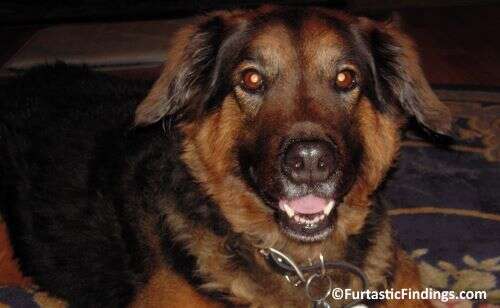
The retina also has a reflective layer called the tapetum lucidum. This layer bounces light back through the retina. It also helps dogs see better at night and is the reason why your dog’s eyes glow when you take a picture of them.
Lens And Cornea
The lens and cornea work together to focus light onto the retina. The cornea is the clear outer layer of the eye. It protects the eye and bends light as it enters.
The lens sits behind the cornea. It changes shape to focus on objects at different distances. This process is called accommodation.
Dogs’ lenses are larger and more rounded than human lenses. This helps them see moving objects better. But it also means they can’t focus as well on close-up objects.
The iris surrounds the lens. It controls how much light enters the eye by changing the size of the pupil.
Eye Muscles
Your dog’s eyes have several muscles that control their movement and shape. These muscles allow dogs to look in different directions without moving their heads.
The extraocular muscles move the eyeball. There are six of these muscles for each eye. They help dogs track moving objects and scan their environment.
Other muscles control the eyelids and third eyelid. The third eyelid, or nictitating membrane, helps protect and lubricate the eye.
Muscles inside the eye also play a role. They change the shape of the lens to focus on objects. They also control the size of the pupil to adjust for different light levels.
Canine Visual Capabilities
Dogs see the world differently than humans. Their eyes have special features that help them in unique ways. This includes how dogs see colors, navigate in low light, and focus on objects.
Color Perception
Dogs don’t see colors the same way you do. Their eyes have fewer color-sensing cells. This means they see fewer colors than humans.
Dogs mainly see blues and yellows. Reds and greens look more like shades of gray to them. This is because they only have two types of color receptors, while humans have three.
Their color vision is similar to what a person with red-green color blindness sees. Dogs can still tell different colors apart, just not as many as you can.
This limited color range doesn’t hold dogs back. They rely more on other senses, like smell, to understand their world.
Night Vision
Dogs see much better than humans in low light. This is due to that special layer called the tapetum lucidum mentioned above. This layer reflects light back through the retina, giving the light receptors a second chance to catch it.
The tapetum lucidum is why dogs’ eyes seem to glow in the dark. It helps them see in dim conditions, like dawn and dusk.
Dogs also have larger pupils than humans. This lets more light into their eyes. Their retinas have more light-sensitive cells called rods. These cells work well in low light but don’t help with color vision.
These features make dogs great at spotting movement in the dark. This skill helped their wild ancestors hunt at night. It is also why your dog may sense movement in your dark yard while you don’t see anything when you look in the same area.
Visual Acuity
Visual acuity is how clearly you can see details. Dogs don’t have as sharp vision as humans do.
A dog’s visual acuity is about 20/75. This means a dog needs to be 20 feet away to see something a person with normal vision can see from 75 feet away. Labrador Retrievers have vision that is closed to human 20/20 vision, which is why most seeing eye dogs tend to be Labs.
Dogs are better at seeing moving objects than still ones. They can spot small movements from far away. This helps them detect prey or threats.
Dogs have a wider field of view than humans. Their eyes are set more to the sides of their heads. This gives them better peripheral vision but less depth perception.
Can Dogs See In Full Darkness?
Dogs can’t see in complete darkness. No animal can create light where there is none. But dogs can see in very low light conditions that would leave you stumbling around.
Their eyes need some light to work with. Even a tiny bit of light, like from stars or the moon, is enough for a dog to navigate.
In pitch black conditions, dogs rely on their other senses. Their excellent hearing and sense of smell take over when their eyes can’t help.
Dogs’ night vision abilities vary by breed. Some breeds, like hounds, have better low-light vision than others.
Caring For Your Dog’s Eyesight
Taking care of your dog’s eyes is key to their health and happiness. Regular veterinarian visits, good food, and a safe home all play a part in keeping those peepers sharp.
Regular Check-Ups
Set up eye exams for your dog every year. Your veterinarian can spot small issues before they get big. They’ll look for signs of cataracts, glaucoma, and other eye problems.
During the check-up, your veterinarian will shine a light in your dog’s eyes. This helps them see if the eyes glow back, which is normal for dogs. They’ll also test how well your pup can see things up close and far away.
If you notice your dog bumping into things or acting scared, don’t wait for the yearly visit. Call your veterinarian right away. Quick action can save your dog’s sight.
Diet And Nutrition
Feed your dog foods rich in vitamins A, C, and E. These help keep eyes healthy. Good choices include:
- Carrots.
- Blueberries.
- Sweet potatoes.
- Fish oil.
Ask your veterinarian about special eye health supplements for dogs. They might suggest adding these to your pup’s diet.
Make sure your dog drinks plenty of water too. This helps eyes stay moist and clean.
Avoid giving your dog table scraps. Some human foods can harm their eyes and overall health.
Environmental Factors
Keep your home safe for your dog’s eyes. Trim bushes and low branches in your yard. Sharp twigs can scratch eyes during playtime.
In the car, don’t let your dog stick their head out the window. Dust and bugs can fly into their eyes.
Clean your dog’s face gently with a damp cloth. This removes dirt that could irritate their eyes.
Canine eyesight is different from ours but well adapted to suit our dog’s needs. Although they are more near-sighted than us and can’t see colors well, they are able to see in low light conditions, can detect movement better than we can and have a greater peripheral vision than we do.
For more information on canine eyesight, see PetMD and the American Kennel Club.
Please check out our other posts on Health, Indoor, Outdoor, and Travel accessories for your dog, as well as Reviews of various products and travel destinations.