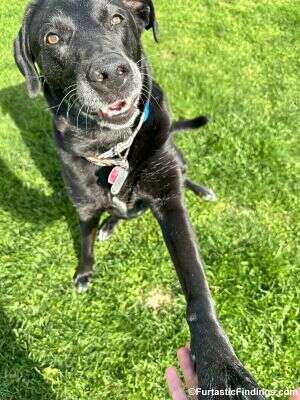
Have you ever noticed when you ask your dog to give you their paw they tend to use the same paw every time you ask them? Our dog does (her left) and it made us wonder, do dogs have a paw preference?
This post will look at if dogs exhibit paw preference, how you can find out if your dog has a paw preference, and some research that has been done on this matter.
Table of Contents:
| Understanding Paw Preference In Dogs |
| Research On Paw Preference Of Dogs |
| Implications Of Paw Preference In Dogs |
| Observing And Recording Paw Use |
Related: Can Dogs Recognize Themselves In A Mirror?
Understanding Paw Preference In Dogs
Just like humans typically favor one hand over the other, many dogs show a preference for using either their right or left paw for certain tasks. This natural tendency reflects brain lateralization and can vary significantly between individual dogs.
The Concept Of Laterality In Dogs
Laterality refers to the preference of using one side of the body over the other. In dogs, this often manifests as a paw preference when performing tasks like steadying food items or reaching for objects.
Research indicates that about 57% of dogs are right-pawed, while approximately 18% prefer their left paw. The remaining 25% are considered ambilateral (or ambidextrous), showing no strong preference for either paw.
Interestingly, some studies suggest paw preference may correlate with sex differences in dogs. This connection mirrors findings in humans, where handedness relates to certain brain functions.
Determining Paw Preference
You can observe your dog’s paw preference through simple tests at home. Watch which paw your dog uses first when:
- Reaching for a toy or treat.
- Steadying a food puzzle or chew.
- Pawing at you for attention.
- Stepping forward first after standing still.
For more accurate results, record your observations over multiple attempts (at least 20-30 trials). A consistent pattern will reveal if your dog has a dominant paw.
Some dogs show different preferences depending on the task. For example, a dog might use its right paw for precision tasks but show no preference for simpler movements.
Testing paw preference isn’t just a fun experiment – it can provide insights into your dog’s brain functioning and behavioral tendencies.
Research On Paw Preference Of Dogs
Scientists have conducted various studies to determine if dogs show paw preferences similar to human handedness. Research reveals interesting patterns in how dogs favor one paw over another when performing certain tasks.
Study Designs And Methods
Researchers use several methods to test paw preference in dogs. The most common test is the Kong test, where treats are placed inside a toy for dogs to retrieve. Scientists observe which paw the dog uses to hold the toy steady.
Another method involves the tape test. Researchers place tape on a dog’s nose or paw and record which paw the dog uses to remove it.
First-stepping tests also provide insights. These tests monitor which paw a dog uses first when walking down stairs or stepping over obstacles.
Some studies use the giving paw command, recording which paw dogs offer most consistently when asked to “shake.”
For accurate results, researchers typically observe 50-100 repetitions of a task. This helps determine if preferences are consistent or random.
Statistical Significance In Paw Preference Studies
Research shows approximately 68% of dogs display either a left or right paw preference, with the remaining showing ambilaterality (no strong preference). This distribution differs from humans, where right-handedness dominates at about 90%.
Studies indicate interesting connections between parent handedness and dog paw preference. Dogs with left-handed parents are significantly more likely to show left-paw bias. Similarly, right-handed parents often have right-pawed dogs.
Some researchers investigate links between paw preference and emotional traits. Dogs with left-paw preferences may respond differently to certain stimuli than right-pawed dogs.
Implications Of Paw Preference In Dogs
Understanding your dog’s paw preference can offer valuable insights into their behavior and cognitive functions. This knowledge can be practical for both training and assessing your pup’s emotional state.
Impacts On Training And Behavior
When training your dog, recognizing their dominant paw can help you develop more effective methods. Dogs with a right paw preference might respond differently to certain commands than those favoring their left paw or those who are ambilateral (using both paws equally).
For example, when teaching tricks that require paw movements, start with your dog’s preferred paw. This approach can speed up the learning process and reduce frustration for both of you.
Some trainers suggest that understanding paw preference can also help with leash training. A right-pawed dog might naturally walk better on your left side, while a left-pawed dog might prefer your right side.
Toys and puzzles can also be positioned to match your dog’s preference, potentially increasing their engagement and problem-solving abilities.
Potential Indicators Of Cognitive And Emotional States
Research suggests that paw preference might relate to how dogs process emotions, though findings are not conclusive. Some studies indicate that strongly lateralized dogs (those with a clear paw preference) may handle stress better than ambilateral dogs.
Observing changes in your dog’s paw usage patterns might provide early signs of cognitive changes or health issues. If your typically right-pawed dog suddenly starts favoring their left paw, it could warrant a veterinary check.
Scientists have explored links between paw preference and personality traits, with some suggesting that right-pawed dogs might show different emotional responses than left-pawed ones. However, as the search results indicate, a 2022 study did not find associations between paw preference and emotionality.
Remember that paw preference appears to be task-specific, meaning your dog might use different paws for different activities.
Observing And Recording Paw Use
To figure out if your dog has a paw preference, you need to observe them in action. Scientists use several reliable methods to test this, and you can try these at home.
The Kong test is a popular method. Fill a Kong toy with treats and watch which paw your dog uses to hold it steady. Record their choice for about 50-100 attempts over several days.
The first-stepping test checks which paw your dog uses first when starting to walk. This natural movement can reveal preferences without any training.
You can also try the treat under paw test. Place a treat under a washcloth and watch which paw your dog uses to uncover it.
For accurate results, perform each test at least 30 times. A clear preference usually emerges when your dog uses one paw for 75% or more of attempts.
Note that your dog might show different preferences for different tasks. This is perfectly normal and adds interesting data to your observations.
So, do dogs have a paw preference? It seems like they do. Research has shown that most dogs have a paw preference when performing everyday tasks, with the majority preferring their right paw. Try giving your dog some of the paw preference tests mentioned above. The results may surprise you!
For more information on paw preference, please see: American Kennel Club, International Journal of Neuroscience, and Animal Cognition.
Please check out our other posts on Health, Indoor, Outdoor, and Travel accessories for your dog, as well as Reviews of various products and travel destinations.